The Reverse Logistics Problem Nobody Talks About: Why Your Reusable Assets Keep Disappearing
Every day, thousands of reusable shipping containers, pallets, and transportation assets complete their outbound journey with full visibility, tracked at every checkpoint, monitored in real-time, and accounted for in sophisticated transportation management systems.
Then they disappear.
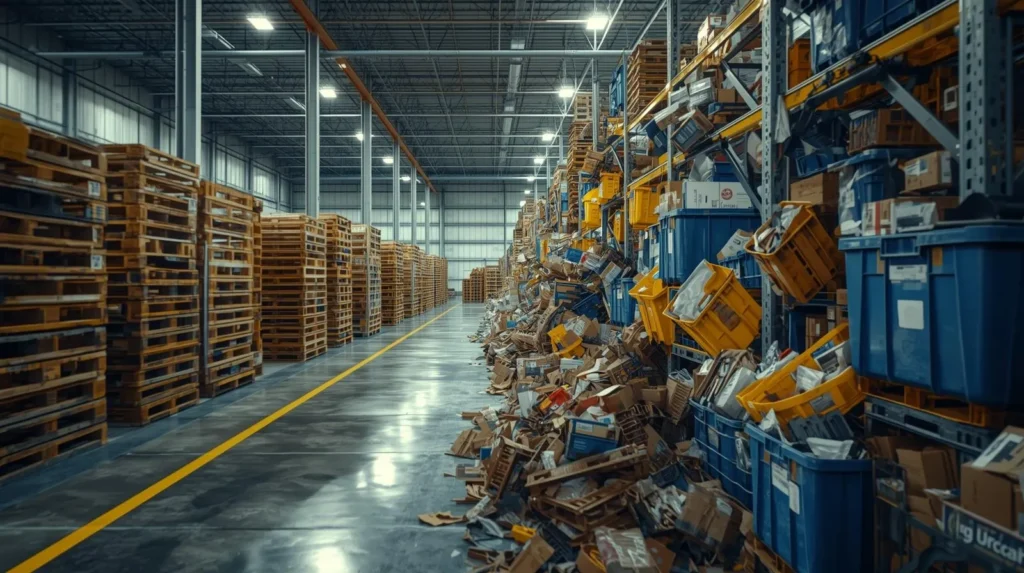
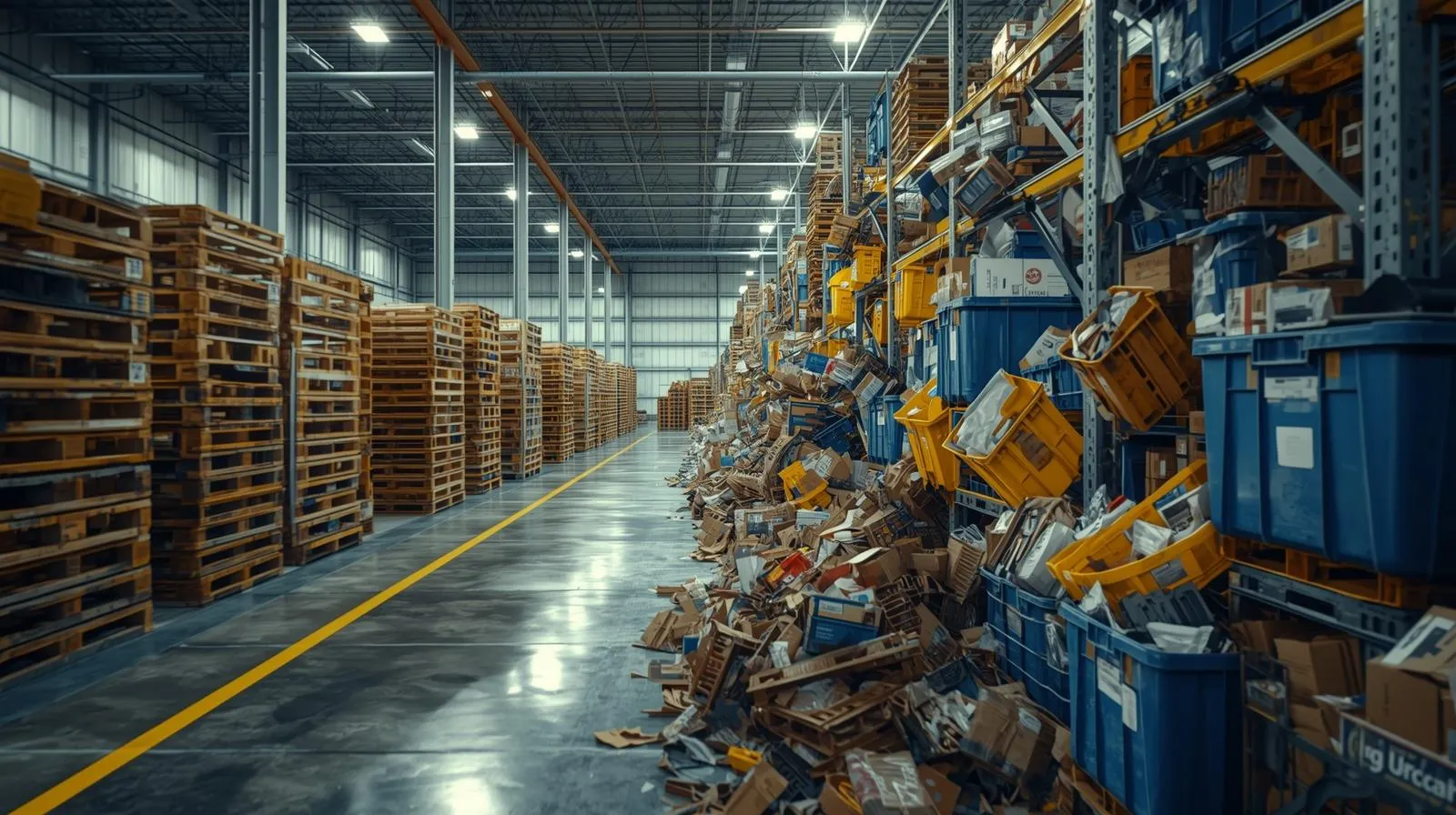
Not literally, of course. They’re sitting in warehouses, staging areas, and facility loading docks around the world. But from a visibility standpoint, they might as well have vanished into thin air. Manual check-ins fail. QR codes don’t get scanned. Reconciliation happens weeks late, if at all. And every year, companies write off millions of dollars in “missing” assets that are simply lost in the reverse logistics void.
If your company manages a reusable asset fleet, whether pharmaceutical shipping containers, retail pallets, event equipment cases, or industrial transport packaging, you’re likely experiencing this problem right now. The question isn’t whether you’re losing assets in reverse logistics. The question is: how much is it costing you?
Why Forward Logistics Gets All the Visibility
Outbound Supply Chain Technology
There’s a reason supply chain technology has historically focused on the outbound journey. It’s where the revenue happens. It’s where customer experience is made or broken. It’s where delays, errors, and visibility gaps have immediate, measurable consequences.
As a result, the forward supply chain has evolved into a sophisticated, data-rich operation:
- Real-time GPS tracking from warehouse to delivery point
- Automated checkpoint scanning at every handoff
- Instant exception alerts when shipments deviate from plan
- Integration with ERP, TMS, and WMS systems
- Detailed analytics on carrier performance, transit times, and delivery success rates
This level of visibility makes perfect sense. When you’re moving products to customers, you need to know exactly where everything is, when it will arrive, and whether any issues require intervention.
The Blind Spot of the Return Journey
But then the asset makes its delivery. The product is unloaded. And the container, pallet, or packaging that carried it begins its return journey, often with a fraction of the visibility, accountability, and technology support that guided it there.
Where Reusable Container Tracking Fails in Reverse Logistics
The return journey is where operational discipline breaks down. Here’s what typically happens:
The “Someone Else’s Problem” Handoff
When a reusable container is emptied at a destination facility, responsibility becomes ambiguous. The delivery driver completed their job. The receiving team accepted the shipment. Now the empty container sits in a staging area, waiting for someone to initiate its return.
In theory, there’s a process: scan the asset, log it in the system, coordinate return transport, and track it back to the origin facility. In practice, that process relies on manual steps that often don’t happen, or happen incorrectly.
Manual Processes That Don’t Scale
Many companies still rely on QR code scanning or manual check-ins to track asset returns. This works in theory, but fails in practice for several reasons:
Human error is inevitable. When operations teams are busy managing inbound shipments, processing returns, and handling exceptions, scanning empty containers becomes a low-priority task. A missed scan here, a delayed entry there, and suddenly your asset visibility has gaps measured in days or weeks.
Different facilities have different standards. A global operation might span 50, 100, or even 200+ facilities across multiple regions. Each site has its own operational rhythm, staffing constraints, and adherence to standard procedures. What gets scanned religiously at one location might be ignored at another.
No one owns the return cycle. Forward logistics has clear ownership, with transportation managers, logistics coordinators, and carrier account managers all having a vested interest. Reverse logistics often falls into a gray area where no single role has explicit accountability.
The Reconciliation Nightmare
Without real-time visibility, companies resort to periodic reconciliation, often monthly or quarterly, to figure out where their assets actually are. This creates a cascade of problems:
- Aging inventory sits undetected. Containers that should have returned weeks ago remain stranded at remote facilities because no one knows they’re there.
- Replacement purchases happen unnecessarily. When assets can’t be located, operations teams order replacements—even though the “missing” containers are simply unaccounted for, not actually lost.
- Financial reporting is inaccurate. Asset values on the balance sheet don’t reflect reality, creating audit issues and misrepresenting operational efficiency.
The Real Cost of Reverse Logistics Blind Spots
Let’s talk numbers, because the financial impact of poor reusable container tracking is substantial and often underestimated.
Direct Asset Loss
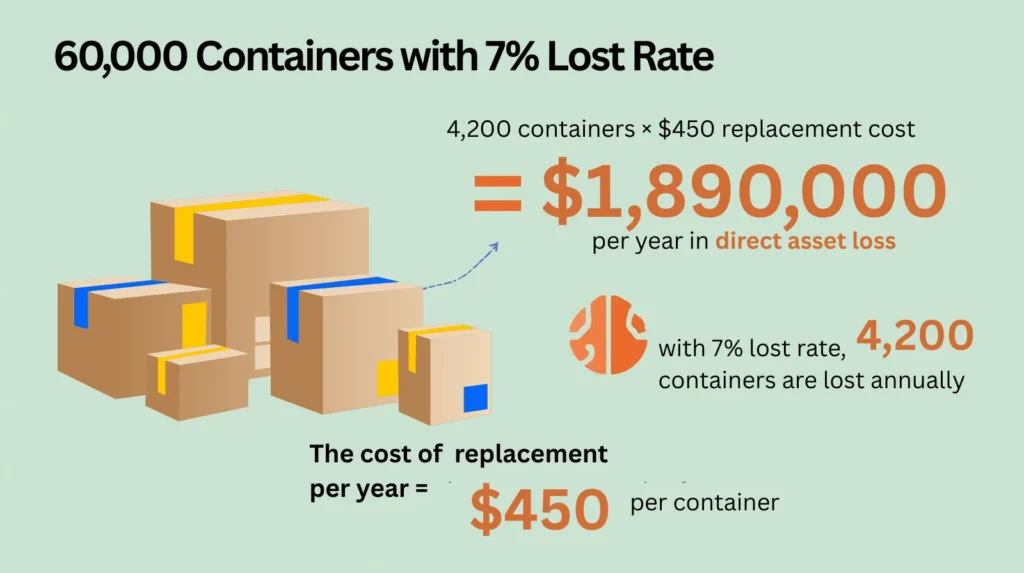
A global logistics company we work with manages approximately 60,000 reusable temperature-controlled shipping containers across 150 facilities worldwide. Each container costs roughly $450 to replace.
Before implementing automated tracking, they experienced an estimated 7% annual shrinkage rate, a figure that aligns with industry benchmarks we’ve observed across logistics, distribution, and manufacturing sectors.
Here’s what that means financially:
- 60,000 containers × 7% loss rate = 4,200 containers lost annually
- 4,200 containers × $450 replacement cost = $1,890,000 per year in direct asset loss
And that’s just the replacement cost. It doesn’t account for:
- Operational disruptions when containers aren’t available for scheduled shipments
- Expedited shipping costs to move replacement assets into position
- Labor costs associated with manual reconciliation and exception handling
Cost breakdown of 7% annual shrinkage
Hidden Operational Costs
Beyond direct asset loss, poor reverse logistics visibility creates operational friction that’s harder to quantify but equally expensive:
Stranded Capital: When reusable containers sit untracked at remote facilities for weeks or months, capital is tied up in assets that should be circulating. For companies with large fleets, this represents millions of dollars in working capital that’s effectively idle.
Inefficient Asset Utilization: Without real-time visibility into where empty containers are located, logistics planners can’t optimize asset redeployment. This leads to situations where one facility is ordering new containers while another facility has dozens sitting unused in storage.
Compliance Risk: In regulated industries such as pharmaceuticals, medical devices, or food distribution, maintaining proper chain-of-custody documentation for reusable transport containers isn’t just good practice; it’s often a regulatory requirement. Gaps in reverse logistics visibility create compliance exposure.
Why Traditional Tracking Methods Fail in Reverse Logistics
If the problem is this obvious and this expensive, why hasn’t it been solved already?
The answer lies in the unique challenges of reverse logistics environments:
Challenge 1: Harsh Environments
Many reusable containers operate in extreme conditions:
- Temperature extremes: Pharmaceutical cold chain containers regularly experience -30°C freezer storage.
- Physical stress: Industrial transport packaging endures rough handling, stacking, and outdoor storage
- RF interference: Metal shelving, concrete walls, and refrigerated chambers create challenging wireless environments
Traditional RFID solutions—which many companies attempted 5-10 years ago—often failed in these conditions. Tags couldn’t penetrate freezer walls. Readers required power infrastructure that was expensive or impossible to install inside temperature-controlled chambers. Battery life was inadequate for long asset lifecycles.
Challenge 2: Infrastructure Constraints
Unlike forward logistics, where GPS tracking works well for assets in transit, reverse logistics primarily involves stationary assets waiting at facilities. This creates different infrastructure requirements:
- Gateway deployment: Fixed infrastructure must be installed at every facility to detect and report asset locations
- Power and connectivity: Gateways need reliable power and network connectivity, which can be challenging in warehouses, staging areas, and outdoor storage yards
- Scalability: Solutions must work cost-effectively across dozens or hundreds of facilities, not just a central hub
Challenge 3: Tag Economics and Form Factor
For reusable container tracking to be economically viable, the tracking tags themselves must meet strict requirements:
Ultra-long battery life: If tags need battery replacement every 12-24 months, the labor cost of maintaining thousands of tags becomes prohibitive. Solutions need 5 years or more of battery life to be practical.
Compact form factor: Tags must be small enough not to interfere with container stacking, handling, or usage. For many applications, this means a small tag, a challenging constraint for devices that need long-range wireless capability and multi-year battery life.
Low per-unit cost: When tracking fleets of 10,000+ assets, even small differences in tag cost matter. Solutions must be affordable at scale.
Durability: Tags must survive the same harsh conditions as the containers they’re tracking—extreme temperatures, moisture, physical impact, and years of operational use.
Challenge 4: Integration Complexity
Effective reverse logistics tracking doesn’t exist in isolation. It must integrate with:
- Asset management systems (ERP, fixed asset registers)
- Transportation management systems (TMS)
- Warehouse management systems (WMS)
- Workflow tools (MS Excel, Google Sheets, internal dashboards, reporting systems)
Many early attempts at container tracking failed not because the technology didn’t work, but because it couldn’t connect with existing operational systems, creating data silos that didn’t improve decision-making.
Modern IoT Solutions for Reusable Container Tracking
The good news: technology has evolved significantly in the past five years, making automated reusable container tracking both technically feasible and economically practical.
LoRa vs Industrial BLE for Reusable Container Tracking
Long-Range, Low-Power Wireless Technologies
Two technologies have emerged as particularly effective for reverse logistics asset tracking:
LoRa (Long Range):
Purpose-built for IoT applications requiring long range (up to several kilometers in open environments, hundreds of meters indoors), low power consumption (enabling 5-10 year battery life), and the ability to penetrate walls, floors, and temperature-controlled environments. LoRa excels in scenarios where assets might be located anywhere within a large facility and where battery replacement would be operationally impractical.
Industrial Bluetooth Low Energy (BLE): Modern industrial-grade BLE tags offer excellent performance for applications requiring more frequent position updates or higher data resolution. While range is more limited than LoRa (typically 50-150 meters depending on environment), BLE infrastructure is often less expensive to deploy and integrates well with mobile devices for field verification.
For organizations evaluating solutions, understanding the trade-offs between Bluetooth and LoRa technologies is critical to selecting the right approach for your specific operational environment.
Gateway Infrastructure That Actually Works
Modern gateway solutions have solved many of the deployment challenges that plagued earlier systems:
Minimal power requirements: Today’s gateways can operate on standard PoE (Power over Ethernet) or even solar power in outdoor applications, eliminating the need for dedicated electrical infrastructure.
Cold-environment compatibility: Industrial-grade gateways are designed to function reliably in the temperature extremes common in pharmaceutical and food logistics operations.
Flexible connectivity: Options for cellular, WiFi, or Ethernet connectivity mean gateways can adapt to whatever network infrastructure exists at a given facility.
Easy deployment: Modern systems can be installed without specialized RF engineering, making multi-site rollouts practical.
Intelligent Software Platforms
Hardware is only half the solution. The real value comes from intelligent asset management platforms that turn raw location data into actionable operational insights:
Automated exception detection: When containers haven’t moved in X days, or when expected returns don’t arrive on schedule, the system generates alerts, eliminating the need for manual reconciliation.
Predictive analytics: By analyzing historical patterns, modern platforms can predict which assets are at risk of being stranded and proactively trigger recovery actions.
Integration via APIs: Modern platforms expose RESTful APIs that enable seamless integration with ERP systems, TMS platforms, and workflow tools, ensuring that data flows into the systems where decisions are actually made.
Multi-facility dashboards: Operations managers can view asset status across all facilities in real-time, making it possible to optimize redeployment and identify systemic operational issues.
Implementing Reverse Logistics Asset Tracking: A Practical Approach
For organizations ready to solve their reverse logistics visibility problem, here’s a practical implementation framework:
Phase 1: Quantify Your Current State
Before investing in any solution, establish baseline metrics:
Calculate your shrinkage rate: How many assets are you writing off annually? What’s the replacement cost?
Map your reverse logistics flow: Document the actual (not theoretical) process by which assets return from field locations to central facilities.
Identify high-loss locations: Some facilities will have significantly higher loss rates than others. Understanding why reveals whether the issue is process, accountability, or facility-specific constraints.
Estimate total cost of the problem: Include direct replacement costs, operational inefficiency, compliance risk, and stranded capital.
Phase 2: Pilot with High-Impact Use Cases
Rather than attempting a full fleet rollout, start with a focused pilot:
Select 1-2 representative facilities where reverse logistics challenges are significant but not catastrophic.
Tag a subset of your asset fleet (500-1,500 containers is often sufficient for meaningful validation).
Define clear success metrics:
- Reduction in shrinkage rate (target: <1% vs. current 7%)
- Improvement in return cycle time (target: X% faster)
- Labor reduction in manual reconciliation (target: Y hours saved per month)
- ROI timeline (target: payback in 12-18 months)
Validate technology performance in your specific operational environment, particularly in challenging RF conditions such as freezers, refrigerated rooms, or metal storage areas.
Phase 3: Scale with Confidence
Once pilot results validate both technical performance and business value:
Develop a phased rollout plan that balances speed of deployment with operational absorption capacity.
Standardize installation procedures so gateway deployment can happen quickly at new facilities without requiring specialized expertise.
Train facility teams on how to interpret system alerts and integrate tracking data into daily operational decisions.
Establish governance and accountability for reverse logistics performance, now that you have the data to measure it.
The Business Case for Automated Container Tracking
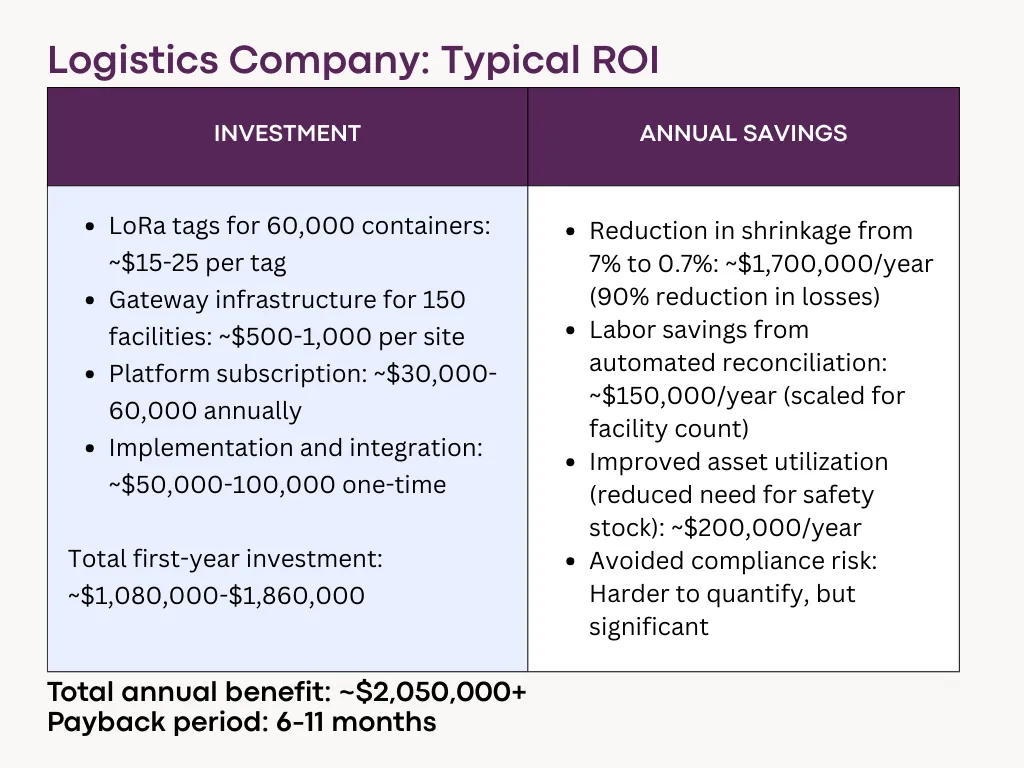
Let’s return to the logistics company example to illustrate typical ROI:
And these benefits compound every year, while the initial infrastructure investment is largely one-time.
For companies with smaller fleets or fewer facilities, the absolute dollar figures will differ, but the ROI math typically remains compelling because the percentage improvements are similar.
Why This Problem Persists (And Why Now Is the Time to Solve It)
If the technology exists and the ROI is clear, why do so many companies still operate with reverse logistics blind spots?
Three reasons:
- The problem is diffuse. Unlike a single catastrophic failure, 7% annual shrinkage happens gradually across many facilities. No single incident triggers a crisis that demands immediate action.
- Organizational inertia. Implementing asset tracking requires coordination across operations, IT, finance, and facility management teams. Without a clear executive sponsor, projects stall in planning.
- Previous solution attempts failed. Many companies tried RFID pilots 5-10 years ago that didn’t deliver promised results. This creates skepticism about new approaches, even though the technology landscape has fundamentally changed.
But three forces are making this the right time to act:
Technology maturation: LoRa and industrial BLE have solved the technical constraints that limited earlier solutions.
Economic pressure: In an era of supply chain disruption and cost optimization, writing off millions in avoidable asset losses is increasingly unacceptable.
Competitive advantage: Early adopters of automated reverse logistics tracking are achieving operational efficiencies that create lasting competitive advantages. As these solutions become standard practice, companies without them will be at a growing disadvantage.
Taking Action: What to Do Next
If your organization manages a reusable asset fleet and you recognize the reverse logistics challenges described in this article, here’s how to move forward:
Step 1: Assess Your Exposure
Calculate your current shrinkage rate, replacement costs, and total reverse logistics footprint. Even a rough estimate will reveal whether this is a $100K problem, a $1M problem, or a $10M problem.
Step 2: Understand Your Options
Modern IoT-based monitoring solutions offer capabilities that weren’t feasible even five years ago. Learn why logistics companies are increasingly adopting IoT-based monitoring to solve visibility challenges.
Step 3: Talk to Your Facilities Teams
The people running your warehouses, distribution centers, and staging areas know exactly where reverse logistics breaks down. Their operational insights will be critical to designing an effective solution.
Step 4: Evaluate Solution Providers
Look for platforms that combine:
- Proven hardware performance in your operational environment
- Flexible integration capabilities with your existing systems
- Experience in your specific industry vertical
- Transparent pricing and realistic implementation timelines
Step 5: Start with a Pilot
Validate performance in your environment before committing to a full rollout. A well-designed pilot should prove (or disprove) the business case within 3-6 months.
Turn Reverse Logistics Blind Spots into a Strategic Advantage
Reverse logistics visibility is the supply chain problem that most companies know exists, but few have prioritized solving. The result: billions of dollars in avoidable asset losses across global logistics operations.
But this isn’t an unsolvable problem. Modern IoT technologies, purpose-built for the challenges of reverse logistics environments, now make automated reusable container tracking both technically feasible and economically compelling.
The question isn’t whether you should implement automated tracking for your reusable asset fleet. The question is whether you can afford to keep writing off 7% of your containers every year when the solution is readily available.
For organizations managing pharmaceutical cold chain containers, retail pallets, industrial transport packaging, or any other reusable asset fleet, Dalos provides unified asset intelligence that eliminates reverse logistics blind spots.
Ready to eliminate shrinkage and gain complete visibility into your reusable asset fleet?
Dalos is a Unified Asset Intelligence Platform that helps enterprises monitor, predict, and optimize the performance of critical assets across their operations. From pharmaceutical cold chain logistics to hospitality network infrastructure, our IoT-driven platform provides real-time visibility and predictive analytics that drive operational efficiency and cost reduction.
Learn more at dalos.co.
Author: Rami El Chafei
Rami El Chafei, CEO & Founder of Dalos, shares impactful insights into the benefits and applications of the Unified Asset Intelligence Platform across hospitality, transportation, and construction industries. His expertise highlights how Dalos enables seamless asset tracking, predictive maintenance, and operational efficiency, transforming these industries with smarter, IoT-driven solutions.
I’m ready to optimize my operations
Get startedRecommended Articles
- Rami El-Chafei
- •
- December 10, 2025
The Reverse Logistics Problem Nobody Talks About: Why Your Reusable Assets Keep Disappearing
If you rely on reusable containers or pallets, your biggest losses may be hiding in reverse logistics. While outbound shipments get full tracking, assets routinely vanish on the return journey—driving...
- Rami El-Chafei
- •
- November 23, 2025
How IoT-Driven Platforms are Transforming Logistics Operations
Transforming Logistic Operations With IOT-Driven Platform As we move further into 2025, the logistics industry is undergoing a profound transformation, largely fueled by the rise of Internet of Things (IoT)...
- Rami El-Chafei
- •
- November 17, 2025
How Dalos Enables Smart Asset Monitoring for Hospitality
Dalos' Smart Asset Monitoring solutions enhance efficiency and elevate guest experiences in the hospitality industry. Leveraging IoT and advanced analytics, streamline operations, optimize asset performance, and ensure seamless service across...